Roof Repair vs. Replacement: How to Know What Your Property Really Needs
The first sign is usually something small. A water stain on the ceiling after a heavy rain. A handful of shingles on the ground after a storm. A commercial property manager getting the same leak call from the same section of roof for the third time this year. The immediate question in every one of those situations is the same: is this a repair, or is this the beginning of a roof replacement? It's a reasonable question, and it's one of the highest-stakes decisions a property owner makes — because getting it wrong in either direction costs money. Replacing a roof that had years of serviceable life left is an unnecessary expense. Repairing a roof that's failing systemically is money spent delaying the inevitable, often while the underlying damage gets worse.
For homeowners and commercial property owners across Kentucky, Southern Indiana, Northern Kentucky, and Greater Cincinnati, the repair-versus-replace decision depends on more than the age of the roof. The roofing material, the installation quality, the extent of the damage, the moisture intrusion history, the roof design, and the maintenance record all influence what the right answer is — and the right answer isn't the same for a fifteen-year-old asphalt shingle roof with one flashing leak as it is for a fifteen-year-old roof that's been leaking in four places. This guide walks through how to think about the decision objectively, what a repair actually covers versus what a replacement involves, how roofing materials change the math, how residential and commercial roofing differ, what roof work costs and why, and when the right next step is a professional inspection rather than a guess.
Quick answer: Roof repair makes sense when the damage is localized and the rest of the roof system is still serviceable — a few missing shingles, a flashing failure at one penetration, or a small area of storm damage. Roof replacement becomes the better decision when the damage is widespread, when leaks keep recurring in different locations, when the roofing material is near the end of its serviceable life, or when the cumulative cost of repeated repairs is approaching the cost of a new roof. The right call depends on the roof's age, the roofing material, the extent and cause of the damage, what an inspection finds in the underlying components, and the long-term cost picture — not on a single rule about roof age. The only accurate way to know is a professional roof inspection and a written estimate based on the actual conditions.
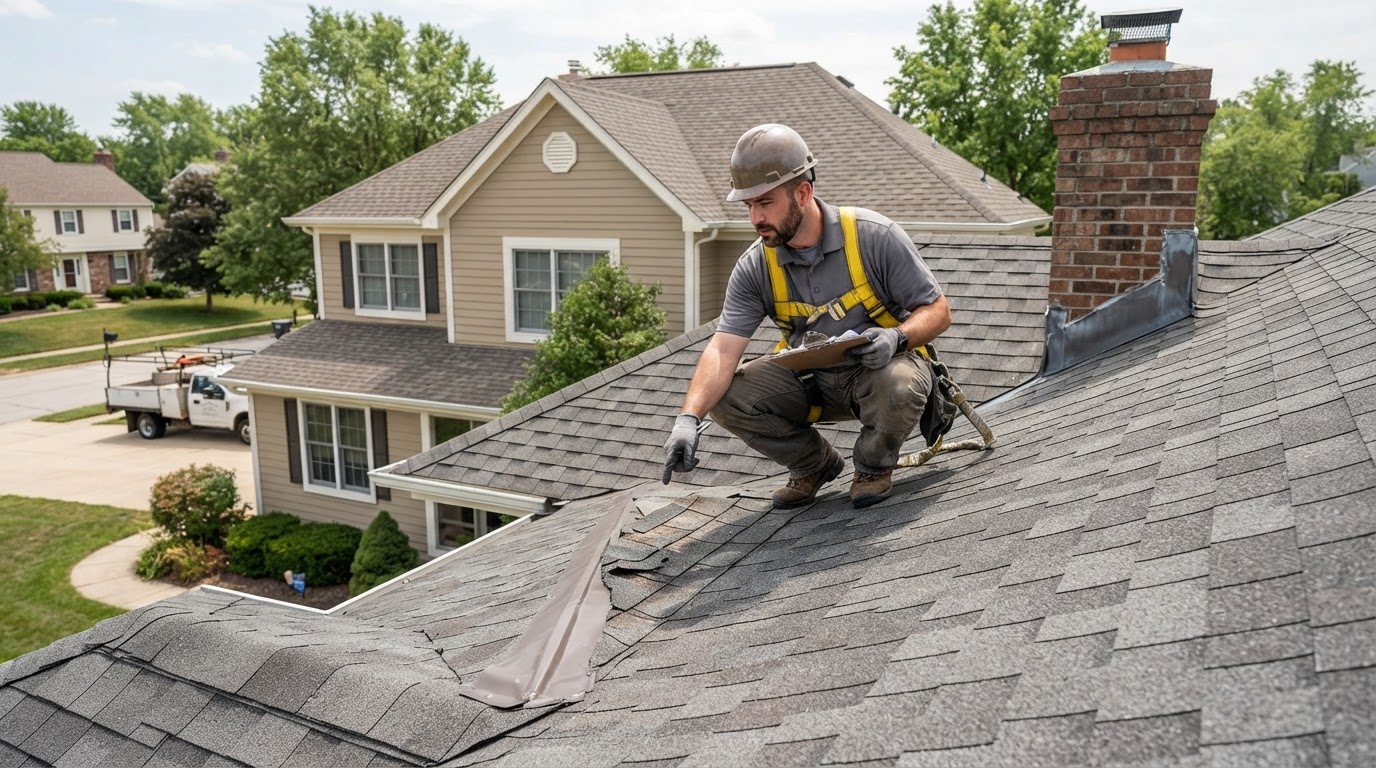
Table of Contents
What's the Difference Between Roof Repair and Roof Replacement?
Roof repair and roof replacement are different scopes of work, different investments, and different commitments — and understanding the distinction is the first step in making the right decision. A roof repair is targeted work intended to correct a specific, localized problem: a section of damaged shingles, a flashing failure at a vent or chimney, a small area of storm damage, or a leak that traces to one identifiable spot. The goal of a repair is to fix what's actually failing without touching the roofing system that's still performing. A roof replacement is the removal and replacement of the existing roof covering — and, where needed, repair of the underlying components like decking, underlayment, flashing, and ventilation — across all or most of the roof. The scope of a replacement varies by roofing system, but the principle is the same: the existing roofing material has reached the end of its useful life or has failed broadly enough that targeted repairs won't solve the underlying condition.
The two differ in cost, disruption, material requirements, and long-term expectations. A repair is a smaller investment that addresses an immediate problem but doesn't reset the service life of the roof — the rest of the system continues to age at the same rate. A replacement is a larger investment that installs a new roofing system with a fresh service life, but it involves removing the existing roof, inspecting and repairing what's underneath, and a longer, more disruptive construction process. Neither is inherently the right answer; the right answer depends on the condition of the specific roof in front of you, which is why the decision starts with an inspection rather than a rule of thumb.
When Is Roof Repair the Better Option?
Roof repair is the better option when the damage is localized and the rest of the roof system is still doing its job. The clearest cases are situations where a specific, identifiable problem can be corrected without replacing roofing material that's still performing — and where fixing that problem restores the roof to a serviceable condition rather than just masking a symptom. These are the situations where a targeted repair is usually the right call:
- Localized shingle damage
- A handful of shingles damaged by wind, impact, or a fallen branch in an area where the surrounding shingles are intact and properly sealed.
- Minor flashing deficiencies
- Flashing at a vent, chimney, skylight, or wall transition that's lifted, corroded, or improperly sealed — a common and very repairable leak source.
- Isolated leaks with a traceable source
- A leak that tracks to one penetration or one section of the roof, where the cause can be identified and corrected rather than a leak that appears everywhere at once.
- Limited storm damage
- Wind or hail damage confined to a defined area of the roof rather than damage spread across the entire roof surface.
- Small areas of damaged roofing material
- A section of membrane, a few shingles, or a patch of deteriorated underlayment that can be replaced without disturbing the surrounding roof.
- Roofs that are otherwise in serviceable condition
- Where the overall roof system is sound, the shingles or membrane aren't at the end of their service life, and the problem is a component failure rather than a system failure.
- Repairable penetrations or transition details
- A plumbing boot, a vent pipe, a drip edge, or a valley that's failed at the detail level — the kind of problem a competent repair addresses permanently.
The critical condition in every one of those cases is that the underlying cause has to be identified, not just the visible symptom covered. A leak at a chimney flashing isn't fixed by adding sealant over the stain on the inside of the ceiling — it's fixed by finding why the flashing failed and correcting that. A repair that covers a symptom without addressing the cause is a repair that will fail again, and the next failure is often worse because the underlying condition has had more time to progress. A good repair corrects the cause, not just the evidence.
A repair extends the serviceable life of the roof only in the area where the roof was still serviceable to begin with. It doesn't reset the condition of the whole roof, and it doesn't stop the rest of the system from continuing to age. If the rest of the roof is already near the end of its service life, a repair buys time — it doesn't solve the problem.
No repair guarantees that a roof will reach a particular age. A roof that's repaired correctly can have years of additional service, and a roof that's repaired to mask a systemic problem can fail again within months. The difference is whether the repair addressed the actual condition — which is why a repair recommendation should always come with an explanation of what was found, what was corrected, and what the remaining condition of the roof is.
When Should Roof Replacement Be Considered?
Roof replacement deserves consideration when the roof system is failing in a way that repairs can't keep up with. That's different from a roof simply being old — a roof that's past the middle of its expected service life but still performing can be a candidate for monitoring rather than replacement, especially if inspections show the underlying components are sound. Replacement is the right conversation when the condition of the roof has reached the point where continued repair is either not technically effective or not economically sensible. These are the conditions that typically move a roof from the repair column to the replacement column:
- Widespread roofing deterioration
- Shingles that are cracking, curling, losing granules broadly, or shedding across the whole roof rather than in one area — signs the material itself is at the end of its service life.
- Repeated leaks in multiple locations
- When leaks keep appearing in different places, the roof is telling you the system is failing, not that there are a series of unrelated component problems.
- Extensive storm damage
- Hail or wind damage across most or all of the roof surface, where repair would mean replacing the majority of the roofing material anyway.
- Significant material failure
- Membrane that's brittle, shingles that have lost their seal, or underlayment that's deteriorated to the point that the roof is no longer reliably shedding water.
- Recurring repairs without lasting results
- When you're calling the same contractor back for the same roof year after year, the cumulative cost and the recurring failures are both pointing toward replacement.
- Underlying decking or substrate concerns
- Soft, rotted, or water-damaged decking discovered during an inspection — because the decking is what the new roofing fastens to, and replacing roofing over failed decking means the new roof fails too.
- Roof systems nearing the end of their serviceable life
- A roof that's at or past its expected service life AND showing condition problems is a different decision than a roof that's old but still performing — age plus condition, not age alone.
- Major installation defects
- A roof that was installed incorrectly — improper underlayment, wrong flashing, inadequate ventilation — may need replacement to correct the systemic defect rather than repair of each symptom it causes.
- Situations where replacement is more economical over time
- When the cumulative cost of the repairs the roof is going to need over the next few years approaches the cost of replacement, replacement becomes the better long-term investment.
Roof age alone doesn't automatically determine whether replacement is necessary, and that distinction matters. A twenty-year-old architectural shingle roof that's been inspected, shows sound decking, and has no leak history may still be performing — and may be a candidate for continued monitoring. A fifteen-year-old roof that's leaking in four places, losing granules into the gutters, and showing cracked shingles across the surface is telling you something different. The decision is driven by the condition the inspection reveals, not by a number on a calendar. That's also why a contractor who recommends replacement without inspecting the roof first — or one who recommends a repair without explaining the remaining condition — is worth a second conversation. The right recommendation comes from what's actually on the roof.
Common Signs Your Roof Needs Professional Attention
Roofing problems announce themselves through visible symptoms long before they become visible from inside the house, but most of those symptoms are easy to dismiss or easy to miss if you're not looking for them. None of these signs automatically means replacement — each one is a reason to get an inspection, which is the step that determines whether the answer is a repair or a replacement. These are the signs that warrant a professional look:
- Missing or damaged shingles
- Shingles on the ground after a storm, or visible gaps in the roof surface where shingles have blown off or broken away.
- Curling or cracked shingles
- Shingles that are curling at the edges, cracking across the surface, or buckling — signs the asphalt is aging and the shingle is losing its seal.
- Water stains on ceilings
- A brown or yellow stain on a ceiling or exterior wall is a leak making itself visible from the inside — and it's almost always worse than the stain suggests.
- Leaks around roof penetrations
- Water appearing near a chimney, vent pipe, skylight, or wall transition where the flashing is the likely culprit.
- Deteriorating flashing
- Flashing that's corroded, lifted, pulling away, or visibly separated from the surface it's supposed to seal.
- Sagging or visibly uneven roof areas
- A roofline that sags, dips, or looks uneven is a potential structural concern — the decking or framing underneath may be compromised, and it needs evaluation before anything else.
- Persistent ponding water on low-slope roofs
- Standing water that doesn't drain within a day or two after rain on a flat or low-slope commercial roof is a drainage problem that will degrade the membrane.
- Damaged seams or membrane sections
- On a commercial membrane roof, seams that are separating, membrane that's blistering or splitting, or areas where the membrane has pulled away from the substrate.
- Unusual moisture conditions
- Damp insulation, mold or mildew in the attic or on interior walls near the roof, or a musty smell that traces to the roof area.
- Repeated leaks after storms
- When the same section of roof leaks every time a storm rolls through, the symptom is consistent — and so is the underlying cause that needs to be identified.
It's important to distinguish a visible symptom from a confirmed cause. A water stain on the ceiling is a symptom — it tells you water got in, but it doesn't tell you where. The cause could be a failed flashing, a damaged shingle, a ice dam, a condensation issue, or a plumbing leak that has nothing to do with the roof. Roof inspection findings are what determine the actual cause and the appropriate repair — which is why the answer to 'I see a stain' is an inspection, not a guess about what to fix.
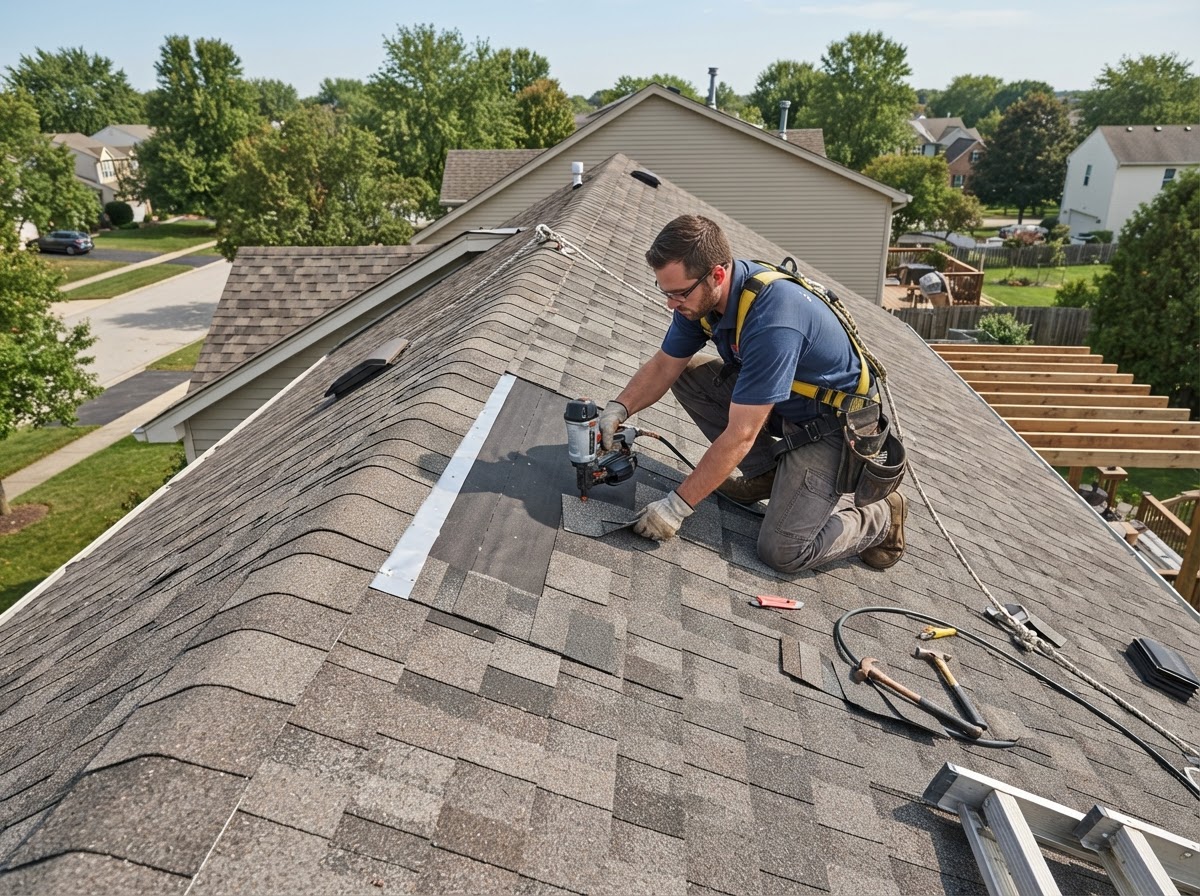
A localized shingle repair is the right call when the damage is confined to a defined area and the surrounding roof is still serviceable — the key is confirming the rest of the roof is sound before deciding the repair is enough.
How Roofing Materials Affect Repair and Replacement Decisions
Different roofing systems age, fail, and get repaired differently, and the material on the roof is one of the biggest factors in whether a problem is a repair or a replacement. The same symptom — a leak — means something different on a fifteen-year-old asphalt shingle roof than it does on a forty-year-old standing-seam metal roof, because the materials fail in different ways and have different service lives. Understanding how the major residential and commercial roofing systems behave helps you interpret what an inspection finds.
- Asphalt shingle roofing
- The most common residential roofing material across Kentucky, Southern Indiana, and Ohio. Architectural (dimensional) shingles typically have a longer service life than older three-tab shingles, and they fail by losing granules, cracking, curling at the edges, and losing their seal strip. Granule loss into the gutters is a normal sign of aging; excessive granule loss that exposes the asphalt underneath is a sign the shingles are nearing the end of their service life. Replacement shingles have to be compatible with the existing roof — matching an older shingle profile and color is difficult, which is why repairs on older shingle roofs can show. A localized shingle repair on an otherwise sound roof is straightforward; widespread cracking or granule loss across the surface is a replacement condition.
- Metal roofing
- Standing-seam and exposed-fastener metal roofs have a long service life and tend to fail at the details rather than the panels — fasteners that back out or corrode, seams that separate, flashing that fails, and panel coatings that degrade. A metal roof repair is often about resealing or replacing fasteners, reflashing a penetration, or replacing a damaged panel. Metal roofs can be excellent candidates for repair because the panels themselves last a long time — but corroded panels, failed coatings across the roof, or widespread fastener failure are replacement conditions. Matching panel profiles and colors for a partial repair can be challenging on an older roof.
- Flat and low-slope roofing
- Common on commercial buildings and on some residential low-slope sections. Membrane systems — TPO, EPDM, modified bitumen, and others — fail at seams, penetrations, flashing details, and drainage points. A membrane roof is often a good repair candidate when the damage is a failed seam, a penetration leak, or a puncture, because those can be patched or reflashed. Widespread membrane aging, brittle and cracked membrane across the roof, saturated insulation underneath, or drainage problems that have degraded the whole surface are replacement conditions. Because membrane roofs depend on the integrity of the insulation and substrate below, an inspection on a leaking commercial roof has to consider what's underneath the membrane, not just the membrane itself.
Where a property has TPO, EPDM, or another commercial membrane roofing system, the repair and replacement approach follows the same logic: the system is evaluated as a whole, not just at the point of the leak. No single roofing material is universally superior — the right material for a low-slope commercial roof isn't the right material for a steep residential roof, and the repairability of each system depends on its age, its installation, and the specific failure. The point of understanding the material is to interpret the inspection findings accurately, not to decide one type of roof is better than another.
Residential Roofing vs. Commercial Roofing
Residential and commercial roofs are built differently, fail differently, and get evaluated differently — and the repair-versus-replace decision has to account for that. A residential roof is typically a steep-slope system designed to shed water quickly: asphalt shingles or metal panels over decking, with attic ventilation, flashing at penetrations, and a roofline that moves water down to the gutters. A commercial roof is typically a low-slope or flat system designed to hold water until it drains: a membrane over insulation over a structural deck, with roof drains, scuppers, and rooftop mechanical equipment. The decision factors are different because the roofs are different.
On the residential side, the considerations are roof pitch, the shingle or metal system, attic ventilation, flashing at chimneys and penetrations, decking condition, and the disruption to the household — a roof replacement is loud, it removes use of the area around the house for the duration, and it has to be sequenced around weather. On the commercial side, the considerations are the membrane system, rooftop mechanical equipment, drainage, the size of the roof area, maintenance records, the business interruption a roofing project causes, access and safety requirements for a working building, and the long-term facility planning that ties a roof decision into the property's capital plan. Commercial roof evaluations often require additional coordination and documentation because the roof is part of a larger building system and the work has to be planned around an operating business.
Commercial roofs are evaluated by square footage, roofing system, accessibility, and project scope — and the inspection has to consider what's under the membrane, not just what's on top. A residential roof is evaluated by pitch, material, flashing, ventilation, and decking condition. The same leak means a different inspection on each.
The scale difference matters too. A residential roof is a defined area with a few penetrations; a commercial roof can be tens of thousands of square feet with dozens of penetrations, multiple drainage paths, and HVAC units that have to be worked around. The cost structure, the scheduling, and the documentation are all different — which is why a commercial roof decision usually involves more planning and a longer evaluation than a residential one. Both start with the same question — what's actually happening on the roof — but the answers come from different inspections.
How Much Does Roof Repair Cost Compared to Replacement in 2026?
Roof repair costs a fraction of what roof replacement costs — that's the basic economics — but the fraction depends entirely on the scope of the repair, the roofing material, the accessibility, and what an inspection finds. A flashing repair at one penetration is a small fraction of a replacement; a repair that involves replacing a significant section of roofing and the decking underneath starts to approach a larger number. The ranges below are broad national and regional averages drawn from widely cited roofing cost sources current as of the article date — not contractor quotes, and not a guarantee of what your specific roof will cost. The only accurate number comes from a roof inspection and a written estimate based on the actual conditions, the actual measurements, and the roofing system on your property.
Cost ranges below are broad national/regional averages for planning, not quotes. Roofing costs depend on the roofing material, the size and pitch of the roof, accessibility, the extent of damage, what an inspection finds in the underlying components, and the applicable permits and disposal. Every roof is estimated individually based on actual scope and the local permitting jurisdiction.
- Minor roof repairs
- A flashing repair, a few replaced shingles, or a small penetration reseal is on the lower end of roof work — a targeted fix at a specific failure point.
- Flashing repairs
- Reflashing a chimney, vent, skylight, or wall transition is more than a shingle replacement because it involves removing and reinstalling the flashing detail — but it's still a repair, not a replacement.
- Leak investigations
- Finding the source of a leak can be straightforward when the entry point is obvious, or it can require inspecting the attic, the roof surface, and the flashing to trace water back to its entry point. The investigation is part of the repair scope.
- Shingle repairs
- Replacing a section of damaged shingles, including underlayment and decking repair where needed, scales with the area — a few square feet is a repair; a significant portion of the roof slope starts to look more like a partial replacement.
- Larger residential roof repairs
- A repair that covers a full roof slope, or that requires decking replacement underneath, is at the higher end of the repair range — and at that point, the inspection should address whether the rest of the roof is sound enough to justify the repair.
- Residential roof replacement
- A full shingle or metal roof replacement is a substantially larger investment, driven by the roof area (in squares — ten feet by ten feet), the roofing material selected, the pitch and complexity of the roof, the condition of the decking, and the tear-off and disposal. A steep, cut-up roof with multiple valleys costs more per square than a simple gable; architectural shingles cost more than three-tab; metal costs more than shingles.
- Commercial roof repairs
- A membrane patch, a seam repair, a penetration reflash, or a drainage correction on a commercial roof is evaluated by the area and the system — a localized membrane repair is a repair; a section of membrane replacement starts to scale with square footage.
- Commercial roof replacement
- A full membrane roof replacement is evaluated by the square foot, the roofing system (TPO, EPDM, modified bitumen, or other), the insulation, the substrate condition, the number and type of penetrations, the drainage design, and the access. Commercial roof costs are almost always quoted by the square foot because the roof areas are large and the systems are specified by coverage.
Commercial roofing is evaluated by square footage, roofing system, accessibility, and project scope because those are the variables that drive the cost — a 20,000-square-foot TPO roof over sound insulation is a different project than a 20,000-square-foot roof that needs insulation replacement and drainage rework. No two roofs cost the same because no two roofs have the same conditions, and the conditions that matter — the material, the decking or substrate, the flashing details, the drainage, the access — are the ones an inspection evaluates. That's why roofing work is estimated from a site visit, not priced from a menu.
The Hidden Costs of Repeated Roof Repairs
There's a point at which repeated repairs stop being economical and start being a delay tactic, and recognizing that point is one of the harder parts of the repair-versus-replace decision — because each individual repair looks reasonable, and it's only the cumulative picture that tells the truth. The hidden costs of a roof that keeps getting repaired aren't just the invoices. They're the interior damage from the leaks that happen between repairs, the disruption to the household or the business each time, the difficulty of matching aging materials on an older roof, the deteriorating underlying components that each leak accelerates, and the growing likelihood that the next repair is the one that finds something worse underneath. Repeated repairs are worth tracking, because the pattern is the signal.
- Cumulative repair expenses
- Add up what the roof has cost over the last two or three years. When the total starts to look like a meaningful fraction of a replacement, the math is telling you something.
- Interior water damage
- Every leak that gets repaired is a leak that already did damage — drywall, insulation, paint, sometimes framing. The interior repairs add to the real cost of each leak.
- Recurring leaks
- A leak in the same place twice means the repair didn't correct the cause. Leaks in different places mean the roof system is failing broadly — a replacement signal, not a repair signal.
- Disruption to occupants or business operations
- Every repair visit is a disruption — for a household, it's noise and access; for a business, it's scheduling, signage, and sometimes lost use of a space. Over years, that adds up.
- Difficulty matching aging materials
- Finding shingles or membrane that match an older roof is harder every year. A repair that doesn't match is a visible repair, and a roof full of visible patches is a roof that's hard to defend as serviceable.
- Deteriorating underlying components
- Each leak lets water reach the decking or substrate, and each time that happens, the component underneath degrades a little more. The repair fixes the roof; the damage underneath keeps accumulating.
- Future maintenance expectations
- A roof that's needed three repairs in two years is going to need more. Planning for that — or replacing the roof before the next repair — is the decision the pattern is pointing toward.
The balance on the other side is that replacing an otherwise serviceable roof prematurely is also an unnecessary expense — and it's a real one. A roof that's past the middle of its expected service life but still performing, with sound decking and no leak history, may be a candidate for inspection and monitoring rather than replacement. The right decision is driven by the condition the inspection reveals, not by a blanket assumption that an older roof has to come off. The goal is to replace the roof when the roof needs replacing, and to repair it when a repair will actually solve the problem — and to know the difference.
Storm Damage — Repair or Replace?
Storm damage is a different decision path than age-related wear, because the damage is sudden and the question is about the extent rather than the service life. A storm can damage a roof that had ten years of life left, and the right response depends on what the storm actually did — not on how old the roof was the day before. These are the storm damage types that show up most often across our Kentucky, Indiana, and Ohio service territory:
- Wind damage
- Shingles lifted or blown off, flashing peeled back, ridge caps displaced. Wind damage is often localized and can be a repair — but if the wind lifted a large area, the seal integrity of the rest of the roof is a question for the inspection.
- Hail damage
- Hail can dent metal, crack shingles, and knock granules off asphalt — damage that may not leak immediately but shortens the service life of the roof. Widespread hail damage is often a replacement; localized hail is a repair.
- Fallen branches and impact damage
- A branch that punctures the roof is an emergency repair, and the extent depends on what it hit — shingles, decking, framing. An inspection determines whether the repair is a patch or a section replacement.
- Wind-driven rain
- Rain forced up under shingles or into flashing can cause leaks without visible exterior damage, which is why a storm that 'didn't look that bad' can still produce interior water — the damage is at the detail level.
- Damaged flashing
- Storm-displaced flashing at a chimney, vent, or wall transition is a repairable detail — but it has to be corrected before the next storm, because the same detail will fail again.
- Punctures and membrane damage
- On a commercial roof, storm debris, hail, or impact can puncture the membrane — a puncture is a repair, but widespread punctures or membrane bruising can be a replacement condition.
- Emergency temporary protection
- A tarp or temporary cover to stop active water intrusion is sometimes the first step, followed by the inspection and the permanent repair or replacement. Temporary protection is not a repair — it's damage control.
After significant storm damage, an inspection matters for two reasons: it determines the real extent of the damage, which is almost always more than what's visible from the ground, and it documents the condition for any applicable insurance coverage. Not all storm damage qualifies for a full replacement, and not every roof that's been through a storm needs one — a roof that took a wind event that removed a few shingles, with the rest of the system intact, is a repair candidate. A roof that took a hail storm that bruised the entire surface is a different conversation. The inspection is what tells those two situations apart, and the documentation is what supports the next step — whatever that is.
Property owners should never climb onto a damaged roof. Storm-damaged roofs can have compromised decking, weakened flashing, and surfaces that are wet, slippery, or structurally unsound. The safe response to suspected storm damage is a professional inspection — not a self-inspection from the roof surface.
Where insurance coverage may apply, the inspection documentation — what was damaged, the extent, and whether the damage is repairable or warrants replacement — is what supports the claim. We don't promise insurance claim approval, because coverage and claim outcomes depend on the policy, the damage, and the insurer. What we can do is inspect the roof, document what we find, and provide the scope and estimate that the process requires — and then complete the approved work to the agreed scope.
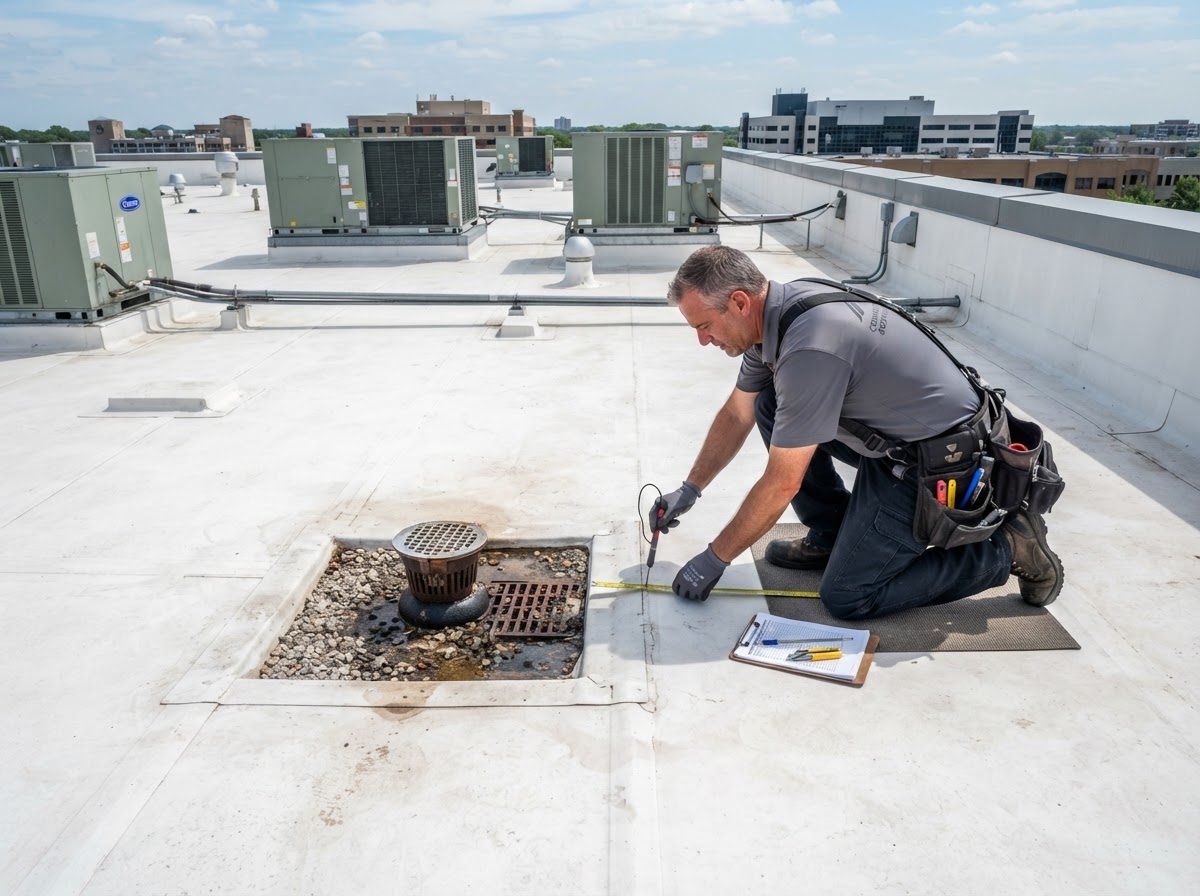
Commercial low-slope roofs are inspected differently than residential steep-slope roofs — the membrane, the seams, the drainage, and what's under the membrane all factor into the repair-or-replace decision.
What Happens During a Professional Roof Inspection?
A roof inspection is the step that turns a symptom into a recommendation, and it's the only reliable way to determine whether the right answer is a repair or a replacement. The inspection evaluates the roof as a system, not just at the point of the visible problem, because the visible problem is often the evidence of a condition that extends beyond it. A qualified roofing professional evaluates the visible roofing material, the flashing at every penetration and transition, the roof penetrations, the drainage, the ventilation where accessible, the accessible attic or interior conditions, the signs of moisture intrusion, the roofing substrate where accessible, and the overall system condition. The goal is to understand not just what's leaking but why — because a repair that doesn't address the cause is a repair that fails.
Some damage is concealed — under the roofing material, in the decking, in the insulation under a commercial membrane, or inside the wall assembly — and may require further investigation to fully identify. A thorough inspection explains what was visible, what wasn't, and what the remaining uncertainty is. The other half of a useful inspection is a clear explanation of the findings and the recommended work — what the problem is, what's causing it, what the repair or replacement options are, and what each one does and doesn't address. A recommendation without that explanation is a price; a recommendation with it is a basis for a decision.
What Happens During Roof Repair or Replacement?
Knowing what the construction process looks like helps set expectations for the disruption, the timeline, and what gets protected along the way. The process is different for a repair and a replacement, and the sequencing varies by roof system and project — but the general flow is consistent.
For a roof repair, the process is: evaluate the problem and identify the source of the damage; determine the appropriate repair scope — what needs to be fixed and what doesn't; prepare and protect the work area, including landscaping, siding, and anything below the repair; complete the repair, including any underlayment, decking, or flashing work the inspection identified; and verify the completed work, including a check that the repair addresses the cause and not just the symptom. A repair is a shorter, less disruptive process, but it still has to be done correctly — a poorly executed repair fails and leaves the underlying condition to progress.
For a roof replacement, the process is more involved: evaluate the existing roof conditions and establish the replacement scope; select the roofing material; obtain permits where required; protect the property — landscaping, siding, windows, and the area around the building; remove the existing roofing where appropriate; inspect and repair the underlying components — decking, underlayment, flashing — as needed, because what's underneath has to be sound before the new roof goes on; install the new roofing system; complete the flashing and ventilation details, which are where most roof failures start; and perform the cleanup, the required inspections, and the final review. The actual sequencing varies by roof system and project — a commercial membrane replacement has a different sequence than a residential shingle replacement — but the principle is the same: the new roof is only as good as what's underneath it and the details that seal it.
A roof replacement isn't just 'new shingles on top.' The decking, underlayment, flashing, and ventilation all get evaluated and corrected during a replacement — which is why a replacement is a better long-term answer when the roof system is failing, and why a replacement costs what it costs. The materials are the visible part; the system underneath is what makes the roof perform.
Roof Maintenance That May Help Prevent Expensive Repairs
Roof maintenance is about catching the small problems before they become the expensive ones, and most of it is straightforward — but none of it guarantees that a roof won't fail. A roof that's maintained gets inspected, gets its drainage kept clear, and gets small issues addressed before they compound. A roof that's ignored ages faster, because the small problems — a lifted flashing, a clogged gutter, a backed-up drain — let water reach places it shouldn't. These are the maintenance steps that matter:
- Periodic professional inspections
- A roof that gets looked at every year or two catches the flashing failure before it becomes the ceiling stain, and the cracked shingle before it becomes the leak. The inspection is the highest-value maintenance there is.
- Gutter and drainage maintenance
- Clogged gutters overflow, and overflowing water finds its way behind the fascia and into the roof edge. Keeping gutters and downspouts clear is roof maintenance, even though it happens at the edge.
- Addressing small leaks promptly
- A small leak is a cheaper repair than a large one, and it's a much cheaper repair than the interior damage that follows if it's ignored. The promptness is the maintenance.
- Checking flashing and penetrations
- Flashing at chimneys, vents, skylights, and wall transitions is where most roof leaks start. Keeping those details sealed and intact prevents the most common leak sources.
- Monitoring storm damage
- After a significant storm, a visual check — from the ground — for missing shingles, displaced flashing, or debris on the roof is worth doing. Anything suspicious gets an inspection.
- Managing debris accumulation
- Leaves, branches, and debris on the roof hold moisture against the roofing material, which accelerates aging. Keeping the roof surface clear extends the service life.
- Maintaining commercial roof drains
- On a low-slope commercial roof, the drains and scuppers have to stay clear — ponding water degrades the membrane and the insulation underneath. Drainage maintenance is the single most important maintenance on a flat roof.
- Documenting previous repairs
- Keeping a record of what's been repaired, when, and why helps the next inspection and the next repair decision. A roof with a maintenance history is easier to evaluate than one without.
None of this prevents every roofing failure — a storm, an installation defect, or a material that fails early can't always be predicted or avoided. What maintenance does is catch the failures that develop over time, the ones that go from a small, inexpensive fix to a larger, more expensive one if they're ignored. The roof that gets maintained lasts longer and fails more predictably than the one that doesn't, and the difference shows up in both the service life and the repair bills over time.
Common Roofing Mistakes Property Owners Should Avoid
The expensive roofing problems are usually the ones that started as a small, avoidable mistake — a leak ignored, a storm damage inspection delayed, a decision made without the right information. These are the mistakes that show up most often, and each one costs more to fix after the fact than it would have cost to avoid:
- 1. Ignoring small leaks
- A small leak doesn't stay small. Water that reaches the decking, the insulation, or the framing does damage continuously, and the repair grows from a flashing fix to a section replacement to an interior restoration. The leak is always cheaper to fix early.
- 2. Delaying inspection after major storm damage
- Storm damage that isn't inspected is damage that keeps doing damage. A tarp is temporary; an inspection is what determines the real scope. The longer the delay, the more the underlying condition progresses.
- 3. Assuming every leak requires replacement
- A leak at a flashing is a repair, not a replacement — and replacing a roof that had a localized problem is an unnecessary expense. The inspection is what tells the difference.
- 4. Repeatedly repairing a failing roof without evaluating overall condition
- A roof that gets repaired three times in three places is a roof that's failing systemically. Each repair looks reasonable; the pattern is the problem, and the pattern is what the inspection should address.
- 5. Choosing roofing materials without considering building requirements
- The roofing material has to suit the roof pitch, the building structure, the local climate, and the applicable code. A material that's wrong for the roof fails early and voids warranties.
- 6. Ignoring ventilation and drainage
- Attic ventilation governs shingle temperature and moisture; drainage governs where water goes. A roof with ventilation or drainage problems ages faster and leaks more, and neither shows up until the damage is done.
- 7. Comparing estimates without reviewing scope
- Two roof estimates that look similar can include different work — different underlayment, different flashing, different ventilation, different disposal. The price is only comparable when the scope is the same.
- 8. Overlooking flashing and roof penetrations
- Flashing is where most leaks start, and it's the most common thing to under-specify on a repair or a replacement. The roof material matters; the flashing details are what actually keep water out.
- 9. Failing to consider commercial maintenance requirements
- A commercial roof isn't a 'replace and forget' asset. Drains have to be kept clear, seams inspected, and the membrane maintained — or the roof fails early and the replacement comes sooner than it should.
- 10. Hiring based solely on the lowest price
- A low roof price that omits underlayment, decking repair, flashing, ventilation, or disposal isn't a lower price — it's incomplete work. The difference shows up in the callbacks, the leaks, and the shorter service life.
Questions to Ask Before Approving Roof Repairs or Replacement
The right questions get the information that turns an estimate into a decision. Before approving roof repairs or a replacement, these are the questions worth asking — and a contractor who can answer them clearly is one who's done the inspection and thought through the scope. Understanding what to ask is also part of vetting a contractor; for a fuller set of questions on hiring, see our guide on how to vet a general contractor.
- What is causing the problem?
- The cause, not the symptom. A recommendation that addresses the symptom without identifying the cause is a repair that will fail.
- Is the damage localized or widespread?
- Localized damage is a repair candidate; widespread damage moves toward replacement. The inspection is what establishes which.
- What repair options are available?
- There may be more than one way to address the problem, with different costs and different long-term expectations. A good estimate presents the options, not just one.
- What are the limitations of repairing the existing roof?
- A repair has limits — it doesn't reset the roof's service life, it doesn't fix underlying conditions, and it may not match an older roof. Knowing the limits is part of deciding.
- Are underlying components damaged?
- Decking, underlayment, insulation, framing — if these are water-damaged, the repair or replacement has to address them, and the cost reflects it.
- What materials will be used?
- The specific roofing material, underlayment, flashing, and ventilation — in writing. 'Shingles' isn't a material specification; the product and the warranty are.
- What is included in the estimate?
- The full scope: tear-off, decking repair, underlayment, flashing, ventilation, disposal, permits, inspections, and cleanup. What's included and what's excluded.
- Are permits required?
- Most roof replacements and many structural roof repairs require a permit and inspection. The permitting jurisdiction depends on where the property sits, and the requirements differ across Kentucky, Indiana, and Ohio.
- What warranties apply?
- Manufacturer warranties on the roofing material and any workmanship warranty on the installation — what each covers and for how long. No specific warranty terms are stated here; warranty terms come from the applicable manufacturer and the service agreement.
- How will the property be protected?
- Landscaping, siding, windows, and the interior — a roof project affects the area around the building, and the estimate should address how that's protected.
Roofing Services Across Kentucky, Southern Indiana & Greater Cincinnati
A Kingdom Construction Co. is headquartered in Louisville, Kentucky, and we take on roofing, roof repair, and roof replacement projects throughout a much larger region than the city alone. Our crews work across Greater Louisville and the surrounding Oldham and Bullitt County communities, along the I-71 corridor that connects Louisville to Northern Kentucky, throughout Northern Kentucky, into Greater Cincinnati and Southwest Ohio, and across Southern Indiana. The same full range of construction services — including residential and commercial roofing — is available throughout that territory, subject to the specific requirements of your project and your local permitting jurisdiction.
Because permitting, licensing, and inspection requirements differ between Kentucky, Indiana, and Ohio, working with a contractor who knows your specific jurisdiction matters. We're familiar with the offices and processes across our service area, so the roofing scope you approve is the scope that gets installed, inspected, and signed off correctly the first time — whether the property is in Louisville, Northern Kentucky, Cincinnati, or Southern Indiana.
Where we work
Need Roof Repairs or Considering Replacement?
The right answer — repair or replace — depends on the actual condition of your roof, not on a rule about age or a guess from the ground. Our team will inspect the roof, explain what we find, and give you a recommendation based on the real conditions: what's causing the problem, how widespread the damage is, what the repair or replacement options are, and what each one does and doesn't address. Whether it's a localized repair on a sound roof or a replacement for a roof that's reached the end of its serviceable life, the right starting point is an inspection and a written estimate based on what's actually on your property.
For more on choosing the right contractor for that inspection, read our guide on how to vet a general contractor — the questions to ask, the insurance to verify, and the contract details that matter before any roofing work begins.
Ready to Start Your Project?
Talk to our team about your kitchen, bathroom, basement, or whole-home project. We'll walk you through the scope, the process, and a realistic estimate.
Frequently Asked Questions
Is it better to repair or replace an old roof?
Can a leaking roof be repaired without replacing it?
How do I know if roof damage is serious?
How much does roof repair typically cost?
How much does a roof replacement cost?
How long does an asphalt shingle roof last?
Can storm-damaged shingles be repaired?
What causes a new roof to leak?
Is commercial roof repair different from residential roof repair?
Can a flat commercial roof be repaired?
How often should a roof be inspected?
What should I look for in a roofing estimate?
Keep Reading
How to Vet a General Contractor: 12 Questions to Ask Before You Sign
Before you sign anything, verify the contractor's license and insurance directly, get a written contract that spells out scope and payment terms, confirm who is pulling permits, and ask to see real photos and talk to a recent customer.
What Does a General Contractor Actually Do? A Homeowner's Guide to Remodeling and Construction
A general contractor does far more than hire subcontractors. Learn what a GC actually handles — planning, permits, scheduling, budgets, change orders, and inspections — and when hiring one makes sense for your remodeling project.
Why Construction Estimates Vary So Much: Understanding What You're Actually Paying For
Three contractors, three very different prices for the same project. Learn what actually drives construction estimate differences — scope, materials, labor, overhead, and hidden conditions — so you can compare bids intelligently instead of just chasing the lowest number.
How Much Does a Home Renovation Cost in 2026? A Homeowner's Guide to Kentucky, Indiana & Ohio
A realistic look at home renovation costs across Kentucky, Southern Indiana, and Greater Cincinnati — what drives price, average ranges for kitchens, bathrooms, basements, and whole-home remodels, plus how to build a renovation budget that actually holds up.
Basement Remodeling in Kentucky, Indiana & Ohio: Costs, Planning, Permits & Common Mistakes
An unfinished or outdated basement can become real living space — but moisture, ceiling height, egress, and below-grade plumbing make it the most condition-dependent renovation there is. Here's what actually drives basement finishing and remodeling costs across Kentucky, Southern Indiana, and Greater Cincinnati, plus how to plan a basement project that stays dry and on budget.
Kitchen Remodeling in Kentucky, Indiana & Ohio: Costs, Planning, Design & Mistakes to Avoid
A kitchen remodel is several projects stacked into one room — cabinets, countertops, plumbing, electrical, flooring, and finish carpentry all coordinated inside the same space. Here's what actually drives kitchen remodeling costs across Kentucky, Southern Indiana, and Greater Cincinnati, how to plan before demolition, and the mistakes that turn a kitchen project into a redo.
Plumbing Services Explained: Repairs, Installations, Upgrades & What Property Owners Should Know
Plumbing is one of the most important systems in any property — and one of the most expensive to ignore. Here's what residential and commercial property owners across Kentucky, Southern Indiana, and Greater Cincinnati should know about plumbing repairs, installations, upgrades, the phases of plumbing during construction, and the decisions that keep a plumbing project from becoming a repair.
Concrete Installation: What Homeowners & Commercial Property Owners Should Know Before Starting a Project
Durable concrete isn't just about pouring and smoothing — it's about what happens underneath. Here's what residential and commercial property owners across Kentucky, Southern Indiana, and Greater Cincinnati should know about site preparation, grading, drainage, reinforcement, finishing, curing, and cost before starting a concrete project.
Drywall Installation & Repair: What Homeowners and Commercial Property Owners Should Know
A smooth, paint-ready wall is the result of correct hanging, taping, multiple coats, and careful sanding — not just panels screwed to studs. Here's what residential and commercial property owners across Kentucky, Southern Indiana, and Greater Cincinnati should know about drywall installation, repair, finishing levels, water damage, and cost before starting a project.