Gutters & Drainage: How to Prevent Water Damage to Your Roof, Siding & Foundation
A homeowner notices water overflowing the gutters during a heavy rain, staining running down the siding, or pooling near the foundation after a storm. A commercial property manager sees water collecting around the building, roof drains overflowing, or the same moisture problem returning season after season. In both cases the first instinct is to look at the gutters — and the gutters are usually part of it — but the gutters are only one piece of a larger water-management system that includes the downspouts, the discharge path, the surface grading, and the building envelope itself.
Uncontrolled roof runoff contributes to siding deterioration, soil erosion, moisture intrusion, and foundation-related concerns, and it does it slowly enough that the damage is easy to ignore until it's expensive. For homeowners and commercial property owners across Kentucky, Southern Indiana, Northern Kentucky, and Greater Cincinnati, understanding how gutters and drainage work together helps with planning, with evaluating estimates, and with knowing when a gutter repair will solve the problem and when the water path underneath it needs to be addressed. This guide covers how gutters, downspouts, and drainage systems work together, how poor drainage damages property, the signs a system needs repair or replacement, repair vs. replacement, gutter materials, residential vs. commercial systems, what gutter work costs and why, sizing and slope, downspouts and foundation protection, the connection to roofing and siding, the professional installation process, gutter guards, seasonal maintenance, common mistakes, when gutter problems point to larger construction issues, hiring questions, and the regional considerations that vary across our service territory. It's written for both residential and commercial property owners, because the fundamentals of managing roof runoff are the same even when the scale and the systems differ.
Quick answer: Gutters are a means of moving water, not a destination. A gutter system that collects roof runoff and dumps it at the foundation has done half the job — the downspouts, extensions, and grading that carry the water away are what actually protect the building. Overflow, sagging, and repeated clogs are signs of a system that's undersized, poorly sloped, or failing, and the right fix depends on whether the problem is isolated or systemic. The only accurate cost for your project comes from a site visit and a written estimate based on the actual run lengths, materials, and conditions.
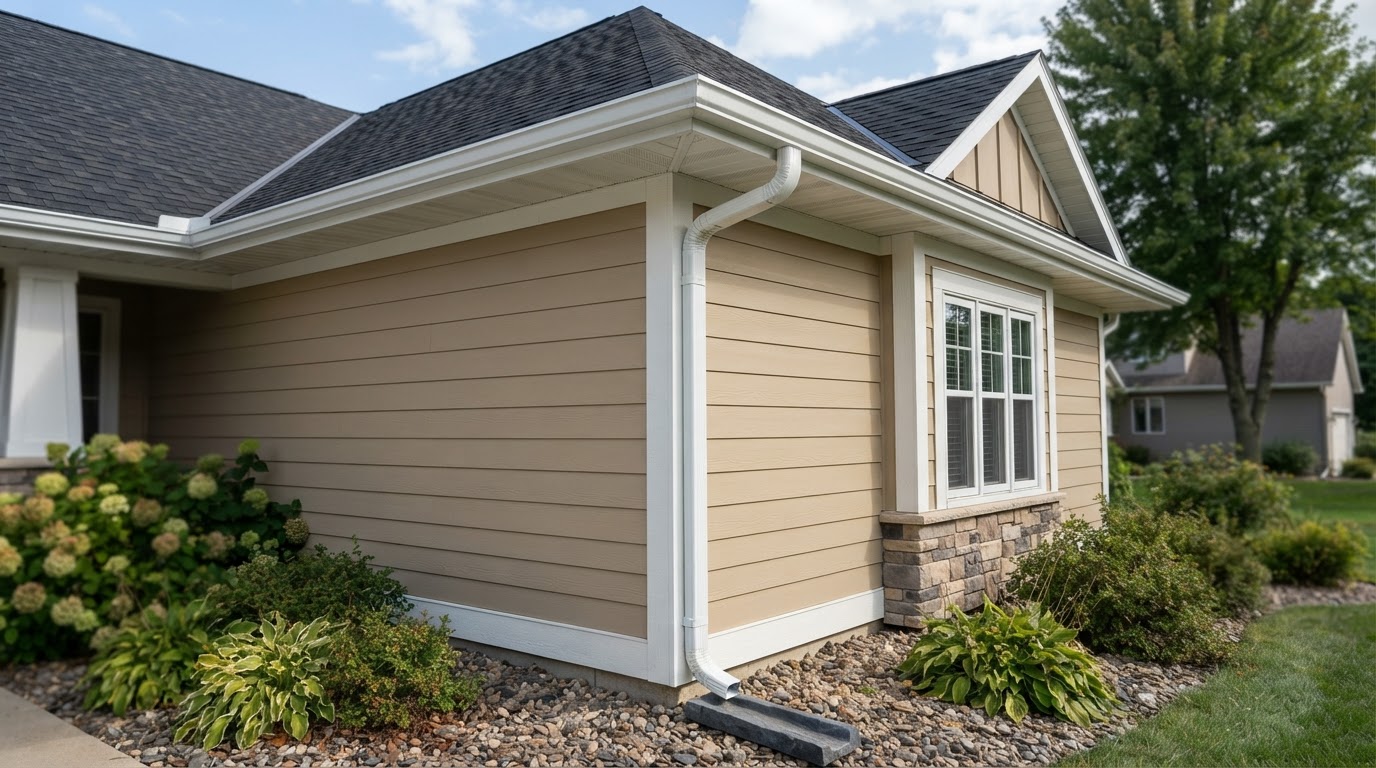
Table of Contents
How Gutters, Downspouts, and Drainage Systems Work Together
Gutters are only one piece of a building's water-management system, and they only work when the rest of the system is doing its part. Roof runoff is collected by the gutter channels along the roof edge, carried to downspouts, discharged through downspout outlets and extensions, and directed to a surface or underground drainage path that moves the water away from the building. If any link in that chain is undersized, clogged, disconnected, or pointed the wrong way, the water goes where it isn't supposed to — over the gutter edge, down the siding, or pooling at the foundation.
Effective drainage is about controlling where the water ends up. The roof sheds it, the gutters collect it, the downspouts move it down, and the discharge path and surface grading carry it away. The goal is to direct runoff toward an appropriate discharge location — a storm drain, a swale, a permeable area, or a designed drainage path — not onto a neighbor's property, a sidewalk, or a spot where it will erode soil or pond against the foundation. A gutter system that drops water three feet from a basement wall hasn't solved the problem; it's just moved it.
- Roof runoff
- The roof surface collects rain and snowmelt and sheds it to the edges. Roof area and pitch determine how much water reaches the gutters and how fast.
- Gutter channels
- Gutters collect the runoff at the roof edge and carry it toward the downspout outlets. Their size, slope, and condition determine whether they can keep up.
- Downspouts
- Downspouts carry the collected water from the gutter to the ground. Their number, size, and placement determine whether the gutters drain efficiently.
- Downspout outlets and extensions
- Outlets connect the gutter to the downspout; extensions carry the discharged water away from the foundation. Extensions and splash blocks are what keep water off the building.
- Underground drainage connections
- Where applicable, downspouts tie into underground piping that carries runoff to a storm system or discharge point. These connections need maintenance to stay clear.
- Surface grading
- The ground around the building should slope away so surface water doesn't pool at the foundation. Grading works with the downspout discharge to keep water moving away.
- Stormwater management
- On larger residential and commercial properties, the overall stormwater plan — swales, catch basins, retention — is part of where the gutter system discharges.
Gutters are a means of moving water, not a destination. A gutter system that collects runoff and dumps it at the foundation has done half the job. The discharge path — extensions, grading, and drainage — is what actually keeps water away from the building.
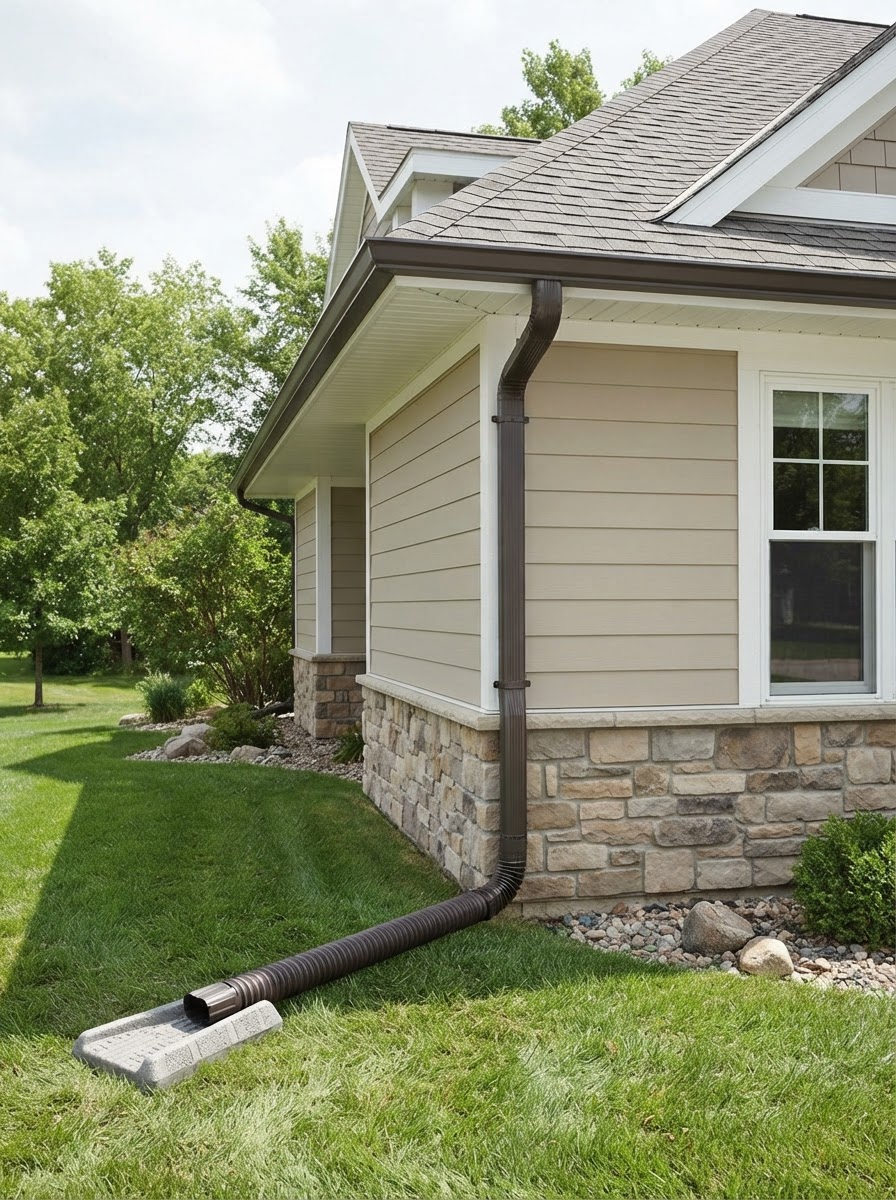
Gutters, downspouts, and discharge extensions work together — the system only protects the building when the water is carried all the way away from the foundation.
How Poor Gutter Drainage Can Damage Your Property
When a gutter system fails — through clogs, undersizing, poor slope, or damage — the water it was supposed to carry goes somewhere else, and that somewhere is usually the building. Roof-edge deterioration, fascia damage, soffit decay, siding staining and moisture intrusion, soil erosion, water accumulation near foundations, basement moisture problems, landscape damage, walkway deterioration, and winter ice hazards can all trace back to runoff that wasn't controlled. These problems rarely have a single cause, and a gutter issue is often one of several contributing factors — which is why the whole drainage path has to be evaluated, not just the gutter itself.
- Roof-edge deterioration
- Runoff overflowing or backing up under the shingles can rot the roof edge and the sheathing behind it.
- Fascia damage
- Gutters fasten to the fascia; when they overflow or leak, the fascia board stays wet and rots, which then undermines the gutter's mounting.
- Soffit deterioration
- Water running behind the gutters can wet the soffits, leading to decay and to moisture entry at the eaves.
- Siding staining and moisture intrusion
- Water cascading over a clogged gutter runs down the siding, leaving stains and, over time, working behind siding joints.
- Soil erosion
- Concentrated discharge at a downspout without an extension erodes the soil below it and can undercut walkways or landscaping.
- Water accumulation near foundations
- Discharge that ends at the foundation wall keeps the soil saturated against the concrete, increasing the chance of seepage.
- Basement moisture problems
- Saturated soil at the foundation is a common contributor to basement dampness — gutters are one part of managing that water.
- Landscape and walkway damage
- Misdirected runoff washes out mulch, drowns plantings, and deteriorates walks and patios over time.
- Winter ice hazards
- Clogged gutters in cold weather contribute to ice buildup at the roof edge, which can damage gutters, shingles, and the roof edge itself.
These problems usually develop slowly, which is why they're easy to ignore until they're expensive. A stained siding wall or a damp basement corner is a symptom; the cause is runoff that wasn't managed. Proper evaluation means looking at the gutter system, the discharge path, the grading, and the building together, because fixing only the visible symptom doesn't correct the water path that created it.
Common Signs Your Gutters Need Repair or Replacement
Gutters tend to fail in predictable ways, and most of them are visible from the ground or during a rain. Sagging gutters, leaking joints, overflow during rain, loose fasteners, detached downspouts, rust or corrosion, cracked gutter sections, standing water, improper slope, repeated clogging, damaged fascia, and water pooling near the building are all signs that the system isn't doing its job. Some of these are repairable; others point toward replacement.
- Sagging gutters
- A gutter pulling away from the fascia means the hangers or the fascia itself are failing. Sagging also creates low spots that hold water.
- Leaking joints
- Drips at seams and corners mean failed sealant or a misaligned joint. Sectional gutters are more prone to joint leaks than seamless.
- Overflow during rain
- Water over the gutter edge during a normal rain points to clogs, undersizing, or too few downspouts — not just a heavy storm.
- Loose or detached fasteners and downspouts
- Fasteners backing out and downspouts pulling loose mean the mounting is failing and the system is losing support.
- Rust, corrosion, or cracks
- Corrosion on steel gutters and cracks in vinyl or aging aluminum are material failure — the gutter is reaching the end of its serviceable life.
- Standing water
- Water that doesn't drain out after the rain means the slope is wrong or the outlet is blocked. Standing water breeds debris and accelerates corrosion.
- Repeated clogging
- If the gutters clog after every leaf fall regardless of cleaning, the system may be undersized or poorly located for the tree coverage.
- Damaged fascia or water pooling at the foundation
- Rot at the fascia and ponding at the base of the downspout are downstream signs that the gutter system has been failing for a while.
The line between repair and replacement usually comes down to how widespread the damage is. A single leaking joint or one sagging section is a repair. Corrosion across multiple sections, repeated leaks at many joints, an undersized system that overflows every storm, or fascia damage under most of the run are signs that patching the system is no longer the economical answer.
Gutter Repair vs. Gutter Replacement
Targeted repairs make sense when the rest of the system is sound. Resealing a leaking joint, reattaching a loose section, correcting a limited slope problem, replacing a damaged downspout section, or addressing localized damage are all repairs that extend the life of a gutter system that's otherwise working. The key is that the repair actually fixes the cause — resealing a joint that leaks because the gutter is undersized doesn't solve the overflow, it just stops one drip.
Replacement becomes the better call when the problems are systemic. Extensive corrosion, repeated leaks across multiple joints, widespread deterioration, an improperly sized system, multiple failing sections, major storm damage, or inadequate drainage capacity are all conditions where a new system performs better and costs less over time than repeated repairs. The right answer depends on the existing system and the property — a 15-year-old gutter with one bad corner is a repair; the same age with corrosion throughout is a replacement.
- Repairs that make sense
- Resealing leaking joints, reattaching loose sections, correcting limited slope problems, replacing damaged downspout sections, and fixing localized damage.
- Conditions that point to replacement
- Extensive corrosion, repeated leaks, widespread deterioration, improper system sizing, multiple failing sections, major storm damage, and inadequate drainage capacity.
Types of Gutter Systems and Materials
Gutter material and system type affect durability, maintenance, appearance, and cost. Aluminum is the most common residential choice — light, corrosion-resistant, available in many colors, and well suited to seamless installation. Steel is stronger but heavier and prone to rust if the coating is damaged. Copper is a premium material that develops a patina and lasts decades, at a higher cost. Vinyl is inexpensive and easy to work with but becomes brittle over time and is more common in sectional DIY systems than in professional installations. Seamless gutters, formed on site to the exact run length, have fewer joints and fewer leak points than sectional gutters, which is why they're the standard for professional residential work.
- Aluminum gutters
- Lightweight, rust-resistant, available in many colors, and the most common material for seamless residential gutters.
- Steel gutters
- Stronger than aluminum but heavier and susceptible to rust if the coating is scratched or wears.
- Copper gutters
- Premium material with a long service life and a distinctive patina; higher cost and typically chosen for appearance and longevity.
- Vinyl gutters
- Inexpensive and easy to install but can become brittle with age and UV exposure; more common in sectional systems.
- Seamless gutters
- Formed on site to the run length, with joints only at corners and downspouts — fewer seams mean fewer leaks.
- Sectional gutters
- Assembled from pre-cut sections; more joints mean more potential leak points and more maintenance over time.
- Residential profiles and commercial box gutters
- Residential gutters use common profiles like K-style; commercial buildings may use box gutters or other systems sized to larger roof areas.
No material is universally best. The right choice depends on the building, the budget, the roof area, the appearance goals, and the maintenance the owner is willing to do. A copper system on a large commercial roof and a seamless aluminum system on a home serve the same purpose at very different price points, and both are correct for their project.
Residential vs. Commercial Gutter and Drainage Systems
Residential and commercial gutter systems do the same job at very different scales. A residential system handles a pitched roof's runoff with gutters sized to the roof area, downspouts placed to drain efficiently, and discharge directed away from the foundation. A commercial system often deals with larger roof areas, low-slope roofs, internal roof drains, scuppers, overflow drainage, and engineered discharge paths — and the maintenance access and business-operations constraints are different. The design requirements aren't interchangeable, and a system that works on a house won't necessarily handle a commercial roof.
- Residential considerations
- Roof pitch, roof area, gutter sizing, downspout locations, fascia condition, landscaping, and basement moisture concerns drive the residential design.
- Commercial considerations
- Larger roof drainage areas, low-slope roofs, internal roof drains, scuppers, overflow drainage, commercial downspouts, maintenance access, business operations, and engineered drainage design.
Internal roof drains and engineered commercial drainage systems may require specialized design and qualified trade coordination. Not every drainage system is a gutter-and-downspout scope, and the right approach depends on the building and the roof system.
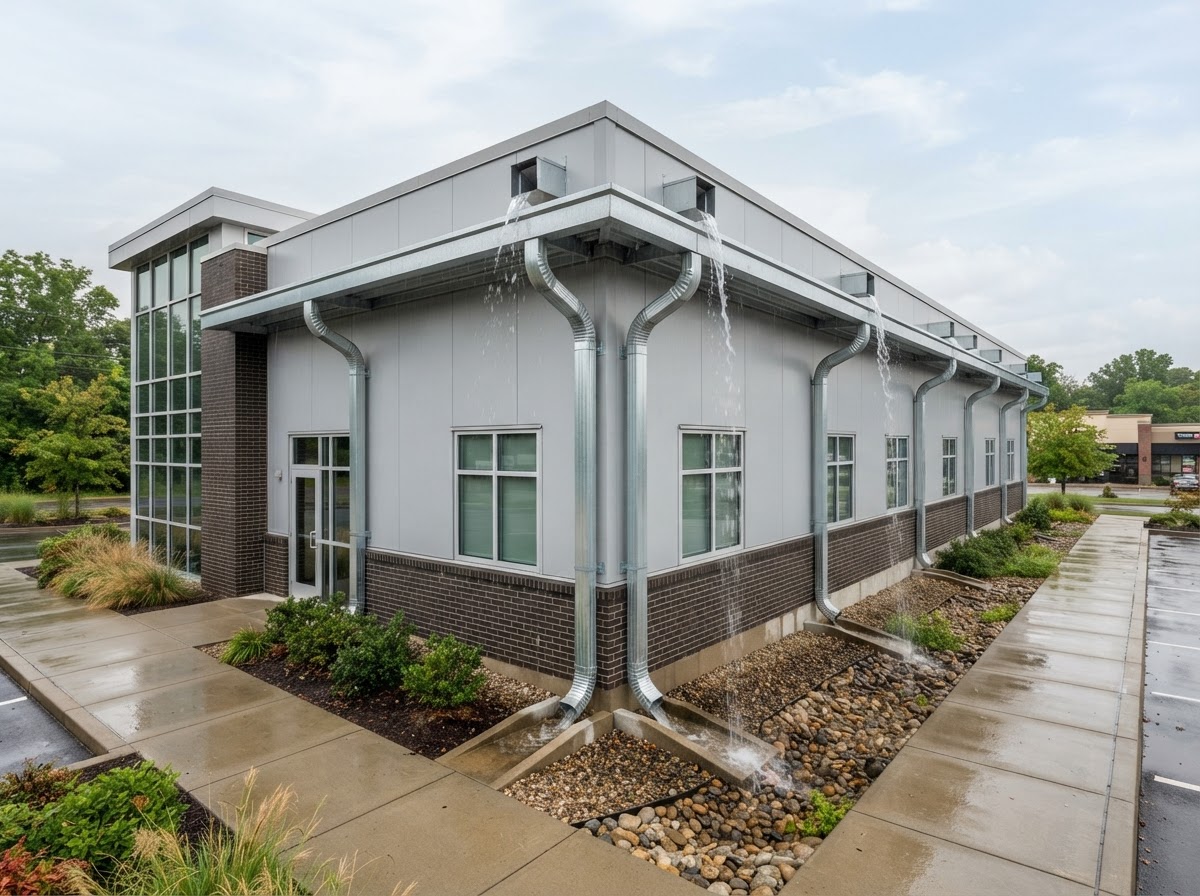
Commercial roof drainage often involves larger areas, internal drains, and scuppers — a different design problem than a residential gutter run.
How Much Does Gutter Installation and Replacement Cost in 2026?
Gutter pricing is driven by the linear footage of the gutter run, the material, the number and size of downspouts, the building height and access, the roof area the system has to handle, the system design, any demolition and disposal of the old gutters, and any underlying fascia or roof-edge repairs that the old system damaged. Broad national and regional averages are useful for planning, but the only accurate number for a specific property comes from a site visit and a written estimate based on the actual run lengths, materials, and conditions.
The figures below are broad national/regional averages drawn from widely cited gutter cost sources (Angi, HomeAdvisor, This Old House) current as of the article date. They are broad averages — not contractor quotes, not a guarantee of any specific project's cost, and not specific to a particular Kentucky, Indiana, or Ohio jurisdiction. Local pricing always requires an individualized estimate.
- Gutter repair (resealing, reattaching, small section fixes)
- Generally the lowest-cost scope — targeted fixes on an otherwise sound system. Cost rises with the number of repair points and access difficulty.
- Seamless aluminum gutter installation (per linear foot, labor and material)
- A common residential range nationally; price moves with material thickness, color, and building height/access.
- Downspout replacement and extensions
- Priced per downspout or per linear foot; extensions and splash blocks are usually a separate line that materially affects foundation protection.
- Gutter guards
- A wide range depending on the guard type — screens, mesh, or solid-cover systems — added to the gutter installation or replacement cost.
- Fascia repairs
- Rot discovered under old gutters is repaired before the new system mounts; the extent of the rot drives the cost.
- Commercial gutter and drainage projects
- Priced by the project — larger roof areas, engineered drainage, access equipment, and coordination all factor in, and commercial scopes are estimated individually.
- Drainage extensions and underground drainage
- Additional drainage work beyond the downspout discharge — extensions, underground piping, and discharge paths — is scoped and priced separately.
What moves a gutter price up or down is the combination of run length, material, building height and access, roof area, system design, demolition, and underlying repairs. A single-story home with easy access and no fascia damage is a different estimate than a two-story home with rotted fascia and an undersized existing system — even if the linear footage is similar. The estimate should reflect the actual scope, including the discharge path, not just the gutter run.
Why Proper Gutter Sizing and Slope Matter
A clean gutter that still overflows is almost always an undersized gutter, a gutter with too few downspouts, or a gutter with the wrong slope. Gutter and downspout capacity depends on the roof area draining into the run, the roof pitch, the local rainfall intensity, the gutter dimensions, the downspout capacity, the outlet locations, and the building configuration. A system sized for a small roof area can't carry the runoff from a large one, no matter how clean it is.
Slope matters because water only moves toward the outlet if the gutter is pitched that way. A gutter installed flat, or with low spots, holds water and debris instead of draining — and standing water accelerates corrosion and clogging. Proper slope toward the outlets keeps the gutter self-cleaning and prevents the standing water that causes most of the long-term damage. There's no universal dimension or slope that's right for every building; the sizing and pitch have to match the roof area, the rainfall, and the downspout layout.
Downspouts and Foundation Protection
Downspouts are where the gutter system either protects the foundation or fails it. A downspout that dumps water at the base of the wall puts exactly the runoff the gutters collected right back against the foundation. Extensions, splash blocks, surface drainage, and grading are what actually move that water away — and underground drainage, where applicable, carries it further. Directing roof runoff away from the foundation is one of the most effective ways to reduce moisture-related problems at the base of a building.
- Downspout positioning
- Downspouts are placed to drain the gutter efficiently and to discharge at a point that allows water to move away from the building.
- Extensions
- Above-ground or buried extensions carry the discharge beyond the foundation wall so water doesn't pond at the base.
- Splash blocks
- A splash block at the downspout outlet prevents soil erosion and starts directing water away from the foundation.
- Surface drainage and grading
- The ground should slope away from the building so surface water — not just downspout discharge — moves away from the foundation.
- Appropriate discharge locations
- Water is directed to a storm drain, swale, or permeable area — not onto a neighbor's property, a walkway, or a spot that will erode or flood.
- Underground drainage where applicable
- Buried downspout lines carry runoff to a distant discharge point and need periodic inspection to stay clear.
Directing water away from the foundation can help reduce moisture-related problems, but persistent foundation or basement moisture may have additional causes — grading, drainage, waterproofing, or structural issues — that need their own evaluation beyond the gutter scope.
How Gutters Connect to Roofing and Siding Repairs
Gutters don't exist in isolation from the rest of the building envelope. The roof edge, drip edge, flashing, fascia, soffits, siding, sheathing, and exterior trim are all connected at the eaves, and water that escapes the gutter system affects all of them. Concealed moisture damage is often discovered during gutter, roofing, or siding work — rotted fascia under a leaking gutter, deteriorated sheathing behind a failing roof edge, or siding damage below an overflow point. Damaged materials have to be evaluated and repaired appropriately, not just covered over with a new gutter.
This is why gutter work often overlaps with roofing and siding scope. Replacing gutters over rotted fascia means the new gutters are mounted to a failing surface; the fascia has to be repaired first. A roof edge that's been leaking behind the gutters may need drip edge or flashing work along with the gutter replacement. Looking at the whole eave assembly — not just the gutter — is what keeps the repair from failing the next season.
Related services
The Professional Gutter Installation Process
A professional gutter installation follows a sequence that protects both the new system and the building it mounts to. The process below is the general sequence — the actual steps vary by property, gutter system, and the condition of the existing roof edge.
- Evaluate the existing system
- Inspect the current gutters, downspouts, fascia, and discharge path to understand what's failing and why.
- Inspect roof edges and fascia
- Check the fascia, soffits, drip edge, and roof edge for damage that needs repair before the new gutters mount.
- Measure the roof drainage areas
- Determine the roof area and pitch draining into each gutter run so the system is sized to the actual load.
- Determine suitable gutter materials and dimensions
- Select the material, profile, and size based on the roof area, rainfall, and the building.
- Plan downspout and discharge locations
- Lay out downspout placement and the discharge path so water is carried away from the foundation.
- Remove existing gutters where required
- Take down the old system and dispose of it, exposing the fascia for inspection and repair.
- Repair damaged mounting surfaces as needed
- Replace rotted fascia or repair the roof edge so the new gutters mount to a sound surface.
- Install gutters and hangers
- Form and hang the gutters with hangers spaced to support the run and the water load.
- Install outlets and downspouts
- Set the outlets and run the downspouts to the planned discharge points.
- Seal applicable joints
- Seal the joints, corners, and end caps that need it to prevent leaks at the connection points.
- Verify alignment and drainage
- Confirm the slope toward the outlets and that the system drains without standing water.
- Complete cleanup and final review
- Clean the site, review the discharge path, and confirm the system is ready.
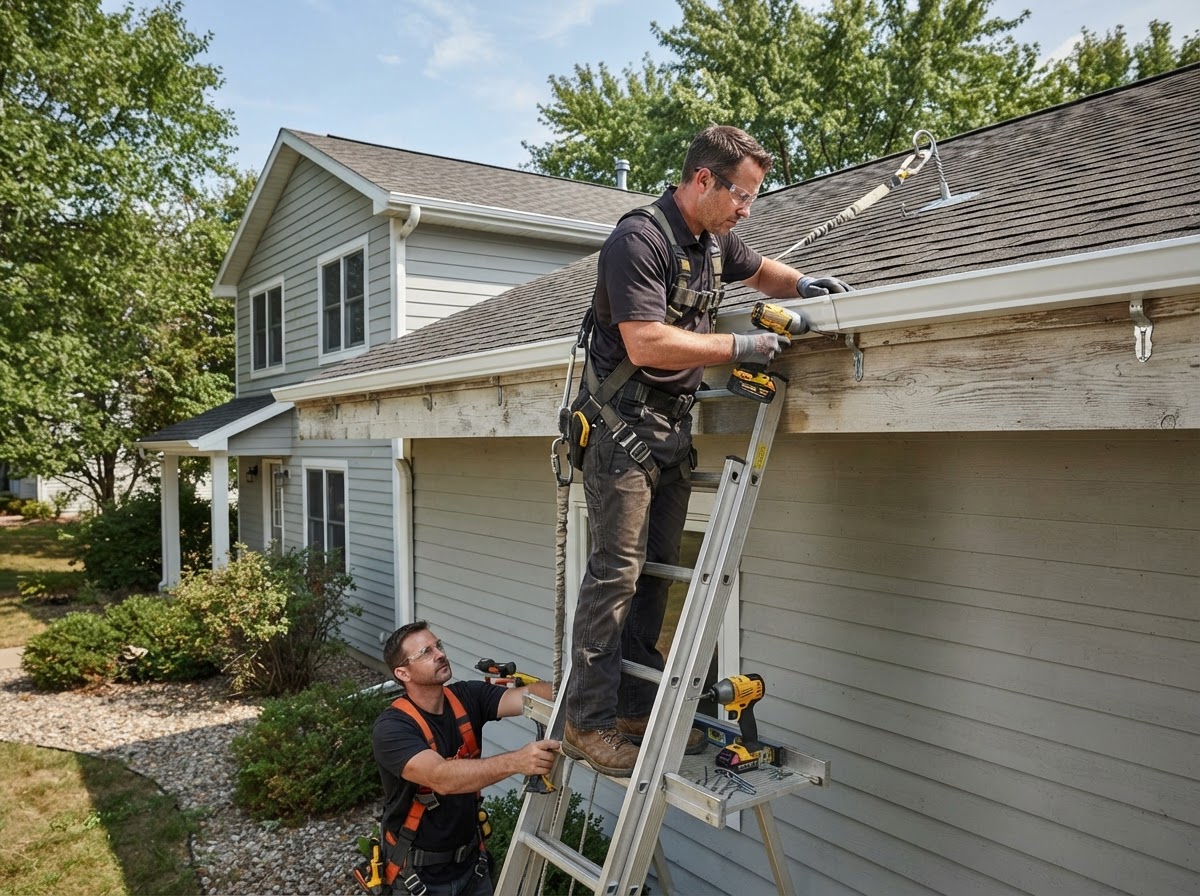
Seamless gutters are formed to the run length on site, with hangers spaced to carry the water load and the slope pitched toward the outlets.
Gutter Guards — Are They Worth It?
Gutter guards can reduce the amount of debris that reaches the gutter channel, but they don't eliminate the need for inspections and maintenance. Leaf screens, mesh guards, and solid-cover systems each handle debris differently, and the right choice depends on the tree coverage around the building, the roof pitch, and the maintenance the owner is willing to do. In heavy tree coverage, even guarded gutters accumulate fine debris, seeds, and granules that eventually need to be cleaned out.
- Leaf screens
- Inexpensive and easy to install; keep out large leaves but can let fine debris through and may need periodic cleaning themselves.
- Mesh guards
- Finer than screens; block more debris but can still collect fine material and shingle granules over time.
- Solid-cover systems
- Surface-tension designs that shed debris while admitting water; higher cost and more effective, but still not maintenance-free.
- Maintenance reality
- Guards reduce cleaning frequency but don't eliminate it. Inspections are still needed to confirm the guards, outlets, and downspouts are clear.
- Regional tree coverage
- Properties surrounded by mature trees benefit more from guards than open properties — the debris load is what drives the value.
Gutter guards are a useful upgrade for the right property, not a set-it-and-forget-it solution. The honest expectation is that they reduce — not remove — the maintenance the gutter system needs, and they're most valuable where the debris load would otherwise clog the gutters repeatedly.
Seasonal Gutter Maintenance in Kentucky, Indiana & Ohio
The region's weather — spring storms, summer downpours, heavy fall leaf drop, and winter freeze-thaw — puts gutter systems through a full cycle every year. Seasonal maintenance keeps the system working through each part of that cycle instead of failing at the worst time.
- Spring
- Check for winter damage — loose hangers, sagging sections, and ice-related displacement — and clear debris that accumulated over the winter.
- Summer
- Monitor drainage during heavy storms. Overflow or pooling during a normal summer downpour points to a clog, undersizing, or a slope problem.
- Fall
- Clear leaves and debris before winter. The fall leaf drop is the single biggest cause of clogs, and a clogged gutter going into freezing weather is a recipe for ice problems.
- Winter
- Watch for ice-related drainage problems and visible damage. Ice at the gutter line can damage the gutter, the roof edge, and the downspouts.
Seasonal inspections are best done from the ground or by a professional with appropriate equipment. Property owners should not climb ladders or access roofs in unsafe conditions — gutter maintenance is not worth a fall.
Common Gutter and Drainage Mistakes to Avoid
Most gutter failures trace back to a handful of avoidable mistakes — in sizing, installation, discharge, and maintenance. Recognizing them is the first step in not repeating them.
- Ignoring overflowing gutters
- Overflow during a normal rain is a sign of a problem, not just a heavy storm. Ignoring it lets the underlying clog, sizing, or slope issue damage the building.
- Installing undersized gutters
- A gutter too small for the roof area overflows no matter how clean it is. Sizing has to match the roof load.
- Using too few downspouts
- Too few downspouts means the gutters can't drain fast enough; the run overflows at the far end before the water reaches the outlet.
- Incorrect gutter slope
- A flat or reverse-sloped gutter holds water and debris instead of draining, accelerating corrosion and clogging.
- Poor fastening methods
- Hangers spaced too far apart or fastened into rotted fascia let the gutter sag and pull away under load.
- Ignoring damaged fascia
- Mounting new gutters to rotted fascia means the system isn't supported — the fascia has to be repaired first.
- Directing water toward foundations
- Downspouts that discharge at the foundation wall put the runoff right back where it causes problems. Extensions and grading carry it away.
- Failing to maintain underground drainage outlets
- Buried downspout lines clog over time; an unmaintained underground line backs water up into the downspout.
- Assuming gutter guards eliminate maintenance
- Guards reduce debris but don't remove the need for inspections. Skipping inspections because of guards leads to hidden clogs.
- Overlooking commercial roof drains
- Commercial low-slope roofs rely on internal drains and scuppers that need their own maintenance schedule, not just the perimeter gutters.
- Delaying repairs after storm damage
- A gutter displaced or damaged by a storm gets worse with the next one. Prompt repair prevents the cascading damage that follows a failing gutter.
- Comparing estimates without reviewing drainage scope
- Two gutter estimates that look similar may include very different discharge, fascia, and downspout work. The scope — not just the price — is what's being compared.
When Gutter Problems May Indicate Larger Construction Issues
Recurring drainage problems are sometimes a symptom of something bigger than the gutters. Roof deterioration, damaged flashing, fascia or soffit damage, siding water intrusion, improper grading, settlement, foundation drainage concerns, and basement moisture problems can all show up first as gutter symptoms — overflow, staining, or moisture at the eaves. When the same drainage problem keeps returning after the gutters are cleaned or repaired, the cause is likely upstream or downstream of the gutter itself.
That's when additional professional evaluation is appropriate — looking at the roof edge, the siding, the grading, and the foundation together rather than treating the gutter as the whole problem. Gutter symptoms alone don't diagnose a structural foundation issue, but they're often the first visible sign that water isn't being managed the way the building needs it to be.
Questions to Ask Before Hiring a Gutter Contractor
The right questions separate a gutter estimate that solves the drainage problem from one that just replaces the metal. Ask these before approving any gutter scope.
- Is the existing system repairable, or does it need replacement?
- A reputable contractor tells you when a repair is sufficient and when replacement is the better call.
- What gutter material is recommended, and why?
- The material should match the building, the roof area, and the budget — not just a default.
- How will gutter sizing be determined?
- Sizing should be based on the roof area and pitch, not a one-size-fits-all dimension.
- Are downspouts included, and how many?
- Downspout count and placement determine whether the gutters actually drain.
- Where will water discharge?
- The discharge path — extensions, grading, drainage — is what protects the foundation, and it should be part of the scope.
- Will damaged fascia be addressed?
- Rotted fascia has to be repaired before the new gutters mount, or the system isn't supported.
- Is removal and disposal of the old system included?
- Demolition and disposal should be a defined part of the estimate, not an extra.
- Are gutter guards included or optional?
- Guards are a separate decision; understand the cost and the maintenance expectation before adding them.
- What warranties or workmanship terms apply?
- Understand what's covered — the gutter material, the installation, and for how long.
- What is included in the estimate?
- The estimate should spell out the run length, material, downspouts, discharge, fascia repairs, and demolition — not just a total.
Gutter and Drainage Services Across Kentucky, Southern Indiana & Greater Cincinnati
A Kingdom Construction Co. is headquartered in Louisville, Kentucky, and we handle gutter installation, repair, replacement, and drainage scope across a much larger region than the city alone. Our crews work throughout Greater Louisville and the surrounding communities, along the I-71 corridor, across Northern Kentucky, into Greater Cincinnati and Southwest Ohio, and throughout Southern Indiana. The same full range of construction services is available throughout that territory — subject to the specific requirements of your project and your local permitting jurisdiction.
Because drainage, grading, and stormwater requirements differ between Kentucky, Indiana, and Ohio jurisdictions, working with a contractor who knows your area matters. The discharge path that's appropriate in one county isn't always the same in the next, and we're familiar with the conditions across our service area so the gutter scope you approve is the scope that protects the building.
Where we work
Need Gutter Repairs or Replacement? Contact A Kingdom Construction
Gutters and drainage are a scope where the system has to be evaluated as a whole — the gutters, the downspouts, the discharge path, and the building they protect. If you're dealing with overflowing gutters, a failing system, or drainage that's directing water toward your foundation anywhere in our service area, our team can walk you through the condition of your existing system, the sizing and slope, the discharge path, and a realistic estimate based on the actual scope. The right recommendation depends on the condition of your gutters and the property — not a one-size-fits-all answer.
Ready to Start Your Project?
Talk to our team about your kitchen, bathroom, basement, or whole-home project. We'll walk you through the scope, the process, and a realistic estimate.
How do I know if my gutters need replacing?
Can leaking gutters be repaired?
How much does gutter replacement cost?
Are seamless gutters better than sectional gutters?
How often should gutters be cleaned?
Do gutter guards eliminate maintenance?
Can clogged gutters cause foundation problems?
Why do my gutters overflow during heavy rain?
How far should downspouts direct water from a building?
What causes gutters to sag?
Are commercial gutters different from residential gutters?
Should gutters be replaced when replacing a roof?
Keep Reading
How to Vet a General Contractor: 12 Questions to Ask Before You Sign
Before you sign anything, verify the contractor's license and insurance directly, get a written contract that spells out scope and payment terms, confirm who is pulling permits, and ask to see real photos and talk to a recent customer.
What Does a General Contractor Actually Do? A Homeowner's Guide to Remodeling and Construction
A general contractor does far more than hire subcontractors. Learn what a GC actually handles — planning, permits, scheduling, budgets, change orders, and inspections — and when hiring one makes sense for your remodeling project.
Why Construction Estimates Vary So Much: Understanding What You're Actually Paying For
Three contractors, three very different prices for the same project. Learn what actually drives construction estimate differences — scope, materials, labor, overhead, and hidden conditions — so you can compare bids intelligently instead of just chasing the lowest number.
How Much Does a Home Renovation Cost in 2026? A Homeowner's Guide to Kentucky, Indiana & Ohio
A realistic look at home renovation costs across Kentucky, Southern Indiana, and Greater Cincinnati — what drives price, average ranges for kitchens, bathrooms, basements, and whole-home remodels, plus how to build a renovation budget that actually holds up.
Basement Remodeling in Kentucky, Indiana & Ohio: Costs, Planning, Permits & Common Mistakes
An unfinished or outdated basement can become real living space — but moisture, ceiling height, egress, and below-grade plumbing make it the most condition-dependent renovation there is. Here's what actually drives basement finishing and remodeling costs across Kentucky, Southern Indiana, and Greater Cincinnati, plus how to plan a basement project that stays dry and on budget.
Kitchen Remodeling in Kentucky, Indiana & Ohio: Costs, Planning, Design & Mistakes to Avoid
A kitchen remodel is several projects stacked into one room — cabinets, countertops, plumbing, electrical, flooring, and finish carpentry all coordinated inside the same space. Here's what actually drives kitchen remodeling costs across Kentucky, Southern Indiana, and Greater Cincinnati, how to plan before demolition, and the mistakes that turn a kitchen project into a redo.
Plumbing Services Explained: Repairs, Installations, Upgrades & What Property Owners Should Know
Plumbing is one of the most important systems in any property — and one of the most expensive to ignore. Here's what residential and commercial property owners across Kentucky, Southern Indiana, and Greater Cincinnati should know about plumbing repairs, installations, upgrades, the phases of plumbing during construction, and the decisions that keep a plumbing project from becoming a repair.
Roof Repair vs. Replacement: How to Know What Your Property Really Needs
A ceiling stain after a storm doesn't automatically mean the whole roof has to come off — but a roof that's been repaired three times in three places may be telling you it's time. Here's how to think through the repair-vs-replace decision for both residential and commercial roofs across Kentucky, Southern Indiana, and Greater Cincinnati, what actually drives the cost difference, and when an inspection is the right next step.
Concrete Installation: What Homeowners & Commercial Property Owners Should Know Before Starting a Project
Durable concrete isn't just about pouring and smoothing — it's about what happens underneath. Here's what residential and commercial property owners across Kentucky, Southern Indiana, and Greater Cincinnati should know about site preparation, grading, drainage, reinforcement, finishing, curing, and cost before starting a concrete project.
Drywall Installation & Repair: What Homeowners and Commercial Property Owners Should Know
A smooth, paint-ready wall is the result of correct hanging, taping, multiple coats, and careful sanding — not just panels screwed to studs. Here's what residential and commercial property owners across Kentucky, Southern Indiana, and Greater Cincinnati should know about drywall installation, repair, finishing levels, water damage, and cost before starting a project.
Interior & Exterior Painting: What Homeowners and Commercial Property Owners Should Know
A lasting paint job is set by what happens before the first coat — surface preparation, drywall repairs, the right primer, compatible coatings, and correct application. Here's what residential and commercial property owners across Kentucky, Southern Indiana, and Greater Cincinnati should know about interior and exterior painting, finishes, costs, and common mistakes before starting a project.